Why your next mobile app is probably headless
Posted on March 18, 2026 • 4 minutes • 833 words
For years, companies fought to get their icon on your phone. They wanted you inside their app: their layout, their offers, their brand.
For years after that, product teams lived and died by UX: smoother flows, clearer buttons, faster loads. Marketers chased click-through rates, conversion funnels, and A/B tests on every step. The whole game assumed a human would see the screen, tap, and stay long enough to care. Success meant more visits, more sessions, more time in-app.
That is starting to change. We used to go places on the web and in apps. Now we often just want something done. The app is still there on the server, but you may never open it.
This is the same shift you already see with Google and Stack Overflow. Once you see the pattern there, “headless” apps are easier to picture.
Google used to send you away
In the 2000s and early 2010s, Google worked like a librarian. You typed a question. You got links. You left Google and opened a blog, a shop, a forum.
The deal was simple: Google listed sites; sites got visitors; Google sold ads next to the list.
Today you often get the answer on the search page with Gemini: a snippet, a box, or a chat reply. You never open the site that did the work. That is faster for you. It also means fewer people visit the source.
So the web is less “a map of places to visit” and more “a pile of facts assistants read.” The old sites can still exist. The habit of clicking through is what fades.
Stack Overflow is already dead
Stack Overflow is a giant public notebook: errors, fixes, and explanations written by real people over many years.
The old habit: copy the error, open Stack Overflow, read, vote, sometimes post an answer.
The new habit for many: paste the error into ChatGPT or Copilot. You get an answer without opening the orange site. You do not add a vote or a follow-up that helps the next person.
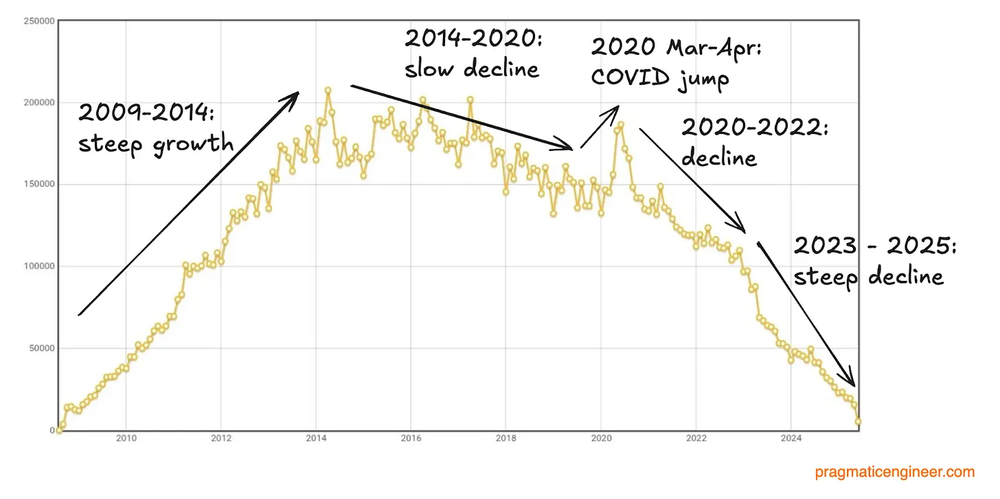
Traffic has fallen drastically. You can see it in public metrics and in how quiet the site feels next to its peak. For a lot of developers it is no longer the first stop. When visits drop that fast, the flywheel stalls: fewer new questions/answers, less voting, less incentive to post the answer that used to help the next person via Google. The corpus does not vanish overnight. It turns into background material for tools, while the living habit moves into the chat box.
That is the same idea as a headless airline or hotel: the real service runs in the back. The place you see is the chat or the phone OS, not their app.
What “headless” means here
Headless does not mean “no screen anywhere.” It means you are not required to use the company’s app or site to finish the job.
You might say: “Book a flight and a hotel in Tokyo.” A helper (with hooks into services, e.g. MCP or other agent APIs) talks to airlines and hotels for you. You might never see their homepage or their “join our club” popup.
The service stays. The shop window you used to walk through matters less.
The future is already here. Watch below to see what an AI-first phone can already do in daily use.
Note: Clicking the video constitutes your consent to view it via YouTube (including cookies). To view it on the YouTube site instead, please use this link.
Where I think this goes in the next few years
Over the next two or three years, I expect a large drop in opens, session length, and “I live in this app” time. Install counts might not move much. Icons will still sit on home screens; the habit of tapping into them for ordinary tasks is what I think breaks first.
Default surfaces win. If the OS or assistant can check in for a flight, reorder food, or resolve “where is my package” without launching the vendor app, most people will stop launching it. The folder of apps you used once a month (“official app just in case”) is the easiest layer to delete from your routine. Heavy daily apps (chat, video, games, niche pro tools) will stay sticky longer; long-tail and transactional apps are the ones whose traffic chart starts to look like Stack Overflow’s.
Builders will still ship native clients for capabilities, push, and store presence. The shift is not “apps vanish.” It is foreground attention moving: fewer sessions inside branded chrome, more tasks finished from one shell that calls backends on your behalf. It is the same headless pattern, now normalized on the device you carry.
I am not betting on usage going to zero. I am betting the curve has already bent, and the next few years make that obvious in the metrics, first for optional and infrequent apps, then for anything the assistant can reliably do without handing you off.